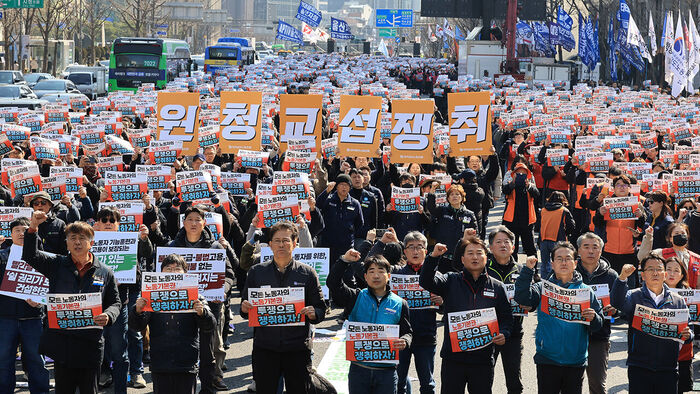
▲ Members of the Korean Confederation of Trade Unions (KCTU) hold signs and chant slogans during a rally in Sejong-ro, Seoul, on March 10, the first day of the implementation of the "Yellow Envelope Act" (amendments to Articles 2 and 3 of the Trade Union and Labor Relations Adjustment Act).
During the 100 days since the implementation of the Yellow Envelope Act, subcontractor unions have requested collective bargaining at 439 principal workplaces, with bargaining procedures underway at 96 sites, including voluntary negotiations and procedures to simplify bargaining channels.
The Ministry of Employment and Labor assessed this as a step-by-step procedural progression rather than a delay in negotiations, though actual bargaining has commenced at only 10 workplaces.
On Monday (June 22), the ministry announced the results of its analysis of bargaining requests made by subcontractor unions to principal workplaces as of June 19.
Since the Yellow Envelope Act took effect on March 10, a total of 1,161 subcontractor unions have demanded negotiations at 439 principal workplaces.
The number of union members involved stands at around 164,000.
Following the bargaining requests, 141 principal workplaces underwent procedures before the Labor Relations Commission regarding issues such as employer status.
Among these, 103 workplaces (73%) were recognized as employers by the commission, and 54 of them are currently undergoing procedures to simplify bargaining channels in accordance with the commission's decision.
In addition, 13 workplaces are undergoing a re-examination process by the National Labor Relations Commission, and four are reviewing subsequent steps.
The remaining 32 workplaces have not yet been served with the written decision.
Including 42 workplaces that engaged in voluntary negotiations, bargaining procedures are underway at a total of 96 sites.
However, due to the step-by-step nature of the procedures, only 10 out of the 439 principal workplaces that received bargaining requests (2.3%), including Incheon Medical Center, have actually entered negotiations.
A ministry official explained, "As it is the early stage of the law's implementation, bargaining requests increased first, and negotiations are now progressing in stages. Once the procedures are completed at each workplace, the number of cases where actual negotiations take place will gradually increase."
The official added, "Even for principal employers and unions, it takes a considerable amount of time to start main negotiations if they go through the process of simplifying bargaining channels. It is difficult to view the progress of negotiations between principal employers and subcontractors as unusually slow."
The ministry also drew a line against concerns raised by some over a "bargaining tsunami," noting that the average number of bargaining requests per principal workplace was around 2.6.
The ministry countered that cases of principal employers appealing the determination of their employer status remain at about one in ten.
Among the 103 workplaces where employer status was recognized, only 13 (12.6%) applied for a re-examination by the National Labor Relations Commission.
"A significant number of principal employers tend to engage in bargaining based on the decisions of the Regional Labor Relations Commissions," the official said. "It is hard to say that seeking a ruling from the National Labor Relations Commission or the courts is the general trend."
The official added, "Once the pending written decisions are disclosed and legal precedents accumulate, both labor and management will have clear criteria for judgment. We do not expect many administrative lawsuits to be filed."
Among the 439 principal workplaces that received bargaining requests, 256 have seen no separate follow-up actions, such as applications for correction to the Labor Relations Commission, by the unions after making their requests.
Regarding this, the ministry viewed that rather than negotiation delays or refusals by principal employers, a significant number of cases involve unions waiting for the commission's decisions or the results of labor-government consultations, depending on the circumstances of each industry and workplace.
Minister of Employment and Labor Kim Young-hoon urged, "I hope the business community will actively engage in negotiations between the parties once a decision is made by the Labor Relations Commission, rather than waiting for a court ruling." He added, "I also ask the unions to focus on resolving issues and achieving bargaining results centered on agendas that the principal employer can substantially control and decide."
(Photo: Yonhap News)
※ Please note: This article was translated by AI and may contain errors.